- Home
- Know Your Consultant
- Our Specialisations
-
Diseases We Treat
- Endoscopy and Other Procedures We Do
- Upper GI tract endoscopy
- Colonoscopy
- Sigmoidoscopy
- Management of gastrointestinal bleeds – variceal banding, sclerotherapy, dennis stents, hemoclips placement, Argon plasma coagulation
- Stricture dilatation
- Fistula closure
- Esophageal stenting for malignancies
- Achalasia cardia dilatation
- Colonic decompression
- Endosonography (EUS)
Diagnostic procedureFine needle aspiration cytology or biopsies- Third space endoscopy
- Motility
High resolution esophageal manometry forAnorectal manometry for- Blog
- Home
- Know Your Consultant
- Our Specialisations
- Diseases We Treat
- Gastroesophageal reflux disease
- Dysphagia
- Esophageal varices
- Cancers
- Corrosive ingestion
- Esophageal stricture
- Achalasia cardia
- Noncardiac chest pain
- Fistulae
- Dysmotility
- Postoperative issues
- Eosinophilic esophagitis
- Foreign body ingestion
- Dyspepsia
- Peptic ulcer disease
- Gastric cancers
- Bleeding
- Gastroparesis
- Altered anatomy-related issues
- Postoperative issues
- Foreign body ingestion
- Acute and chronic diarrhea
- Inflammatory bowel diseases
- Intestinal obstruction
- Malabsorption
- Irritable bowel syndrome
- Intestinal cancers
- Intestinal bleed
- Constipation – difficult to treat
- Constipation – difficult to treat
- Incontinence
- Anorectal/ defecatory disorders which need Anorectal evaluation
- Solitary rectal ulcer syndrome
- Acute and chronic pancreatitis
- Recurrent acute pancreatitis
- Pancreatic malignancies
- Pancreatic space-occupying lesions or cysts
- Autoimmune pancreatitis
- Gallstone diseases
- CBD stones/strictures / malignancies
- Post-operative issues
- Intra-abdominal masses evaluation
- Mesenteric diseases
- Ascites cirrhotic and non-cirrhotic
- Gastro-intestinal and liver disease as part of other systemic diseases
- Retroviral other immunity related gastrointestinal and liver issues
- Jaundice for evaluation
- Vascular diseases of the liver
- Liver malignancies
- Any space-occupying lesion
- Evaluation for transplant
- Acute liver failure
- Hepatitis/cirrhosis
- Viral
- Alcoholic
- Wilson
- Autoimmune
- NAFLD
- Others and Cryptogenic
- Endoscopy and Other Procedures We Do
- Upper GI tract endoscopy
- Colonoscopy
- Sigmoidoscopy
- Management of gastrointestinal bleeds – variceal banding, sclerotherapy, dennis stents, hemoclips placement, Argon plasma coagulation
- Stricture dilatation
- Fistula closure
- Esophageal stenting for malignancies
- Achalasia cardia dilatation
- Colonic decompression
- PEG –Percutaneous endoscopic gastrostomy tube placement
- Colonic stricture dilatation and colonic stent placement
- ERCP
- Bile duct and pancreatic stones
- Bile duct and pancreatic leaks
- Bile duct and pancreatic strictures
- Pancreato-biliary cancers
- Spiral enteroscopy
- Cholangio-pancreatoscopy
- Endosonography (EUS)
Diagnostic procedure- For pancreato-biliary diseases
- Superficial cancers staging
- Submucosal lesions assessment
- Submucosal lesions assessment
Fine needle aspiration cytology or biopsies- Pancreatic malignancies
- Cystic lesions in pancreas
- Biliary or other malignancies
- Intrabdominal/intra-thoracic lymphadenopathy
Therapeutic EUS- EUS guided pseudocysts drainage
- EUS guided celiac plexus neurolysis/celiac block
- EUS guided biliary drainage
- EUS guided vascular interventions
- EUS guided gastro-jejunostomy
- Third space endoscopy
- Per-oral endoscopic myotomy
- Endoscopic submucosal dissection
- Endoscopic full thickness resection
- Motility
High resolution esophageal manometry for- Dysmotility
- Achalasia cardia
- Preoperative before Fundoplication
Anorectal manometry for- Defecatory disorders
- Anorectal dyssynergia
- Biofeedback therapy for Anorectal disorders
- Blog
- Endoscopy and Other Procedures We Do
Pancreatic Malignancies
Pancreatic Malignancies
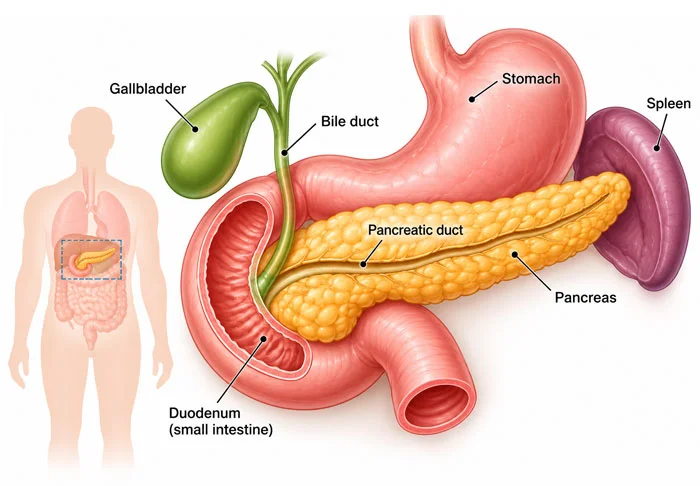
Pancreatic malignancies are cancers that develop in the pancreas. The most common type is pancreatic ductal adenocarcinoma, which usually develops from the cells lining the pancreatic ducts. Other less common pancreatic tumors may arise from endocrine cells or other pancreatic tissues.
Pancreatic cancers can be difficult to detect in their early stages because symptoms may be subtle or absent initially. Symptoms and treatment options depend on the location, size, type, and stage of the tumor, as well as the patient's overall health.
Common Symptoms
- Upper Abdominal Pain: Persistent discomfort in the upper abdomen that may sometimes radiate to the back.
- Jaundice: Yellowing of the skin or eyes, particularly when a tumor obstructs the bile duct.
- Unexplained Weight Loss: Unintentional loss of weight or reduced appetite.
- Digestive Problems: Nausea, changes in bowel habits, or difficulty digesting food.
- Changes in Blood Sugar: New or worsening diabetes may occur in some patients.
- Fatigue: Persistent tiredness or reduced energy.
Types of Pancreatic Malignancies
Pancreatic tumors can develop from different types of cells. These include pancreatic ductal adenocarcinoma, pancreatic neuroendocrine tumors, and less common cystic or other malignant tumors. The exact type of tumor is important in determining the appropriate treatment approach.
Risk Factors
Several factors may increase the risk of pancreatic cancer, including increasing age, smoking, chronic pancreatitis, certain inherited genetic conditions, family history of pancreatic cancer, obesity, and some metabolic conditions. Having a risk factor does not necessarily mean that a person will develop pancreatic cancer.
Diagnosis
Evaluation usually includes a detailed medical history, physical examination, blood tests, and imaging. Investigations such as contrast-enhanced CT scan, MRI/MRCP, endoscopic ultrasound (EUS), and selected tumor-marker tests may be used to evaluate a suspected pancreatic tumor.
In selected cases, an EUS-guided biopsy may be performed to obtain tissue for pathological examination. Additional investigations may be required to determine whether the disease has spread and to assess whether surgery is appropriate.
Treatment
Treatment depends on the type and stage of the cancer, its location, whether it can be surgically removed, and the patient's overall health. Depending on the individual situation, treatment may include surgery, chemotherapy, radiotherapy, targeted therapy, immunotherapy, or a combination of these approaches.
For tumors that can be surgically removed, procedures such as Whipple surgery (pancreaticoduodenectomy), distal pancreatectomy, or other pancreatic surgery may be considered. Treatment planning is often coordinated by a multidisciplinary team.
Management of Bile Duct Obstruction
Some pancreatic tumors can obstruct the bile duct and cause jaundice. In selected patients, endoscopic procedures such as ERCP with biliary stent placement may be used to restore bile flow and relieve symptoms.
Importance of Early Evaluation
Persistent jaundice, unexplained weight loss, ongoing upper abdominal or back pain, changes in bowel habits, or newly developed blood sugar problems should be evaluated appropriately. Early diagnosis helps determine the extent of disease and allows treatment options to be considered at the appropriate stage.
When to Consult a Specialist?
Patients with persistent abdominal pain, unexplained weight loss, jaundice, digestive symptoms, or imaging findings suggestive of a pancreatic lesion should undergo specialist evaluation. A gastroenterologist, pancreaticobiliary specialist, or multidisciplinary cancer team can guide further investigation and treatment.
- Home
- Know Your Consultant
- Our Specialisations
- Diseases We Treat
- Endoscopy and Other Procedures We Do
- Upper GI tract endoscopy
- Colonoscopy
- Sigmoidoscopy
- Management of gastrointestinal bleeds
- Stricture dilatation
- Fistula closure
- Esophageal stenting for malignancies
- Achalasia cardia dilatation
- Colonic decompression
- PEG
- Colonic stricture dilatation and colonic stent placement
- Endo-sonography (EUS)
- Therapeutic EUS
- Third space endoscopy
- Motility
- Blog