Esophageal Stenting for Malignancies
Esophageal Stenting for Malignancies
Esophageal stenting is an endoscopic procedure used to relieve narrowing or blockage of the esophagus caused by esophageal or nearby gastrointestinal cancers.
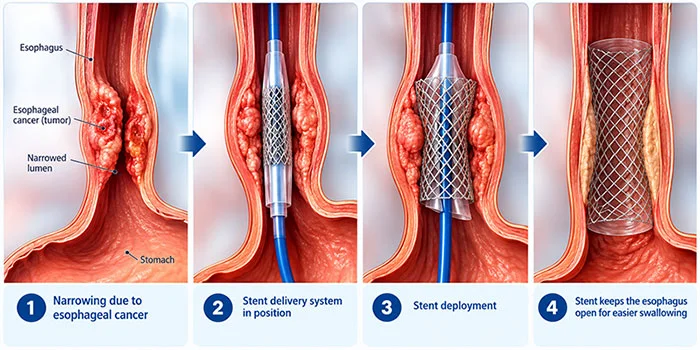
As an esophageal tumor grows, it may narrow the food pipe and make swallowing increasingly difficult. A specially designed self-expanding metal stent can be placed across the narrowed area to help keep the esophagus open.
The main goal of stenting is to improve swallowing, facilitate oral intake, and provide symptom relief in appropriately selected patients.
Why is Esophageal Stenting Performed?
Esophageal stenting may be considered when a malignant tumor causes significant narrowing of the esophageal passage and affects the patient's ability to swallow.
- Difficulty swallowing: Helps improve passage of food and liquids.
- Malignant esophageal obstruction: Helps open the narrowed section caused by a tumor.
- Advanced cancer: May provide palliative relief when curative treatment is not possible.
- Persistent symptoms: Can help improve oral intake and reduce obstruction-related discomfort.
- Selected malignant fistulas or leaks: A covered stent may sometimes be used to seal an abnormal communication.
How Does an Esophageal Stent Work?
An esophageal stent is a flexible, expandable tube that is placed across the narrowed section of the esophagus.
Once positioned correctly, the stent expands and presses against the surrounding tumor, creating a wider channel through which food and liquids can pass.
Many stents used for malignant obstruction are self-expanding metal stents, and covered or partially covered designs may be selected depending on the clinical situation.
What Happens During the Procedure?
The procedure is performed using an endoscope. The doctor first examines the esophagus and identifies the location and extent of the narrowing.
A guidewire may be passed through the narrowed area, followed by positioning of the stent at the appropriate location.
The stent is then released and allowed to expand across the tumor. The doctor confirms its position and evaluates the passage through the esophagus.
Conditions Where Stenting May Be Used
- Esophageal cancer
- Gastroesophageal junction malignancies
- Selected cancers causing external compression of the esophagus
- Malignant esophageal obstruction
- Selected malignant esophageal fistulas
Benefits of Esophageal Stenting
- Improves swallowing: Helps restore passage through a narrowed esophagus.
- Improves oral intake: May allow patients to consume food and liquids more comfortably.
- Minimally invasive: Performed endoscopically without open surgery.
- Rapid symptom relief: Swallowing may improve after the stent expands.
- Palliative treatment: Can improve comfort and quality of life in appropriately selected patients with advanced malignancy.
Preparation Before Stenting
Before the procedure, the doctor evaluates the patient's symptoms, nutritional status, tumor location, imaging findings, and overall medical condition.
Patients are generally required to fast before the procedure. The medical team should be informed about all medications, particularly blood thinners and medicines that may require adjustment.
After Esophageal Stent Placement
Patients are monitored after the procedure and receive specific instructions regarding diet and activity.
A gradual progression of diet may be recommended. Patients are often advised to take adequate fluids and follow the dietary instructions provided by their treating team.
Follow-up is important to monitor swallowing, nutritional intake, stent position, and possible complications.
Possible Risks and Complications
Although esophageal stenting is commonly used for palliation of malignant obstruction, complications can occur.
- Chest discomfort or pain
- Difficulty swallowing immediately after placement
- Stent migration
- Tumor ingrowth or overgrowth
- Food obstruction of the stent
- Bleeding
- Perforation, which is uncommon
- Fistula formation or worsening of an existing fistula in selected cases
Follow-up After Stenting
Regular follow-up helps assess whether the stent is functioning properly and whether swallowing has improved.
Patients should report new or worsening difficulty swallowing, chest pain, vomiting, bleeding, fever, or inability to tolerate food and liquids.
Further endoscopic treatment may occasionally be required if the stent becomes blocked, migrates, or is affected by tumor growth.
When Should You Consult a Gastroenterologist?
Patients with progressive difficulty swallowing, inability to tolerate food or liquids, recurrent vomiting, unexplained weight loss, or known esophageal malignancy should undergo specialist evaluation.
The gastroenterology team can assess whether esophageal stenting, other endoscopic treatment, nutritional support, radiation therapy, surgery, or another approach is appropriate.
Conclusion
Esophageal stenting is an important endoscopic option for selected patients with malignant esophageal obstruction. By keeping the narrowed passage open, a stent can help improve swallowing and oral intake and provide symptom relief.
Careful patient selection, appropriate stent placement, dietary guidance, and follow-up are important for achieving the best possible outcome.