- Home
- Know Your Consultant
- Our Specialisations
-
Diseases We Treat
- Endoscopy and Other Procedures We Do
- Upper GI tract endoscopy
- Colonoscopy
- Sigmoidoscopy
- Management of gastrointestinal bleeds – variceal banding, sclerotherapy, dennis stents, hemoclips placement, Argon plasma coagulation
- Stricture dilatation
- Fistula closure
- Esophageal stenting for malignancies
- Achalasia cardia dilatation
- Colonic decompression
- Endosonography (EUS)
Diagnostic procedureFine needle aspiration cytology or biopsies- Third space endoscopy
- Motility
High resolution esophageal manometry forAnorectal manometry for- Blog
- Home
- Know Your Consultant
- Our Specialisations
- Diseases We Treat
- Gastroesophageal reflux disease
- Dysphagia
- Esophageal varices
- Cancers
- Corrosive ingestion
- Esophageal stricture
- Achalasia cardia
- Noncardiac chest pain
- Fistulae
- Dysmotility
- Postoperative issues
- Eosinophilic esophagitis
- Foreign body ingestion
- Dyspepsia
- Peptic ulcer disease
- Gastric cancers
- Bleeding
- Gastroparesis
- Altered anatomy-related issues
- Postoperative issues
- Foreign body ingestion
- Acute and chronic diarrhea
- Inflammatory bowel diseases
- Intestinal obstruction
- Malabsorption
- Irritable bowel syndrome
- Intestinal cancers
- Intestinal bleed
- Constipation – difficult to treat
- Constipation – difficult to treat
- Incontinence
- Anorectal/ defecatory disorders which need Anorectal evaluation
- Solitary rectal ulcer syndrome
- Acute and chronic pancreatitis
- Recurrent acute pancreatitis
- Pancreatic malignancies
- Pancreatic space-occupying lesions or cysts
- Autoimmune pancreatitis
- Gallstone diseases
- CBD stones/strictures / malignancies
- Post-operative issues
- Intra-abdominal masses evaluation
- Mesenteric diseases
- Ascites cirrhotic and non-cirrhotic
- Gastro-intestinal and liver disease as part of other systemic diseases
- Retroviral other immunity related gastrointestinal and liver issues
- Jaundice for evaluation
- Vascular diseases of the liver
- Liver malignancies
- Any space-occupying lesion
- Evaluation for transplant
- Acute liver failure
- Hepatitis/cirrhosis
- Viral
- Alcoholic
- Wilson
- Autoimmune
- NAFLD
- Others and Cryptogenic
- Endoscopy and Other Procedures We Do
- Upper GI tract endoscopy
- Colonoscopy
- Sigmoidoscopy
- Management of gastrointestinal bleeds – variceal banding, sclerotherapy, dennis stents, hemoclips placement, Argon plasma coagulation
- Stricture dilatation
- Fistula closure
- Esophageal stenting for malignancies
- Achalasia cardia dilatation
- Colonic decompression
- PEG –Percutaneous endoscopic gastrostomy tube placement
- Colonic stricture dilatation and colonic stent placement
- ERCP
- Bile duct and pancreatic stones
- Bile duct and pancreatic leaks
- Bile duct and pancreatic strictures
- Pancreato-biliary cancers
- Spiral enteroscopy
- Cholangio-pancreatoscopy
- Endosonography (EUS)
Diagnostic procedure- For pancreato-biliary diseases
- Superficial cancers staging
- Submucosal lesions assessment
- Submucosal lesions assessment
Fine needle aspiration cytology or biopsies- Pancreatic malignancies
- Cystic lesions in pancreas
- Biliary or other malignancies
- Intrabdominal/intra-thoracic lymphadenopathy
Therapeutic EUS- EUS guided pseudocysts drainage
- EUS guided celiac plexus neurolysis/celiac block
- EUS guided biliary drainage
- EUS guided vascular interventions
- EUS guided gastro-jejunostomy
- Third space endoscopy
- Per-oral endoscopic myotomy
- Endoscopic submucosal dissection
- Endoscopic full thickness resection
- Motility
High resolution esophageal manometry for- Dysmotility
- Achalasia cardia
- Preoperative before Fundoplication
Anorectal manometry for- Defecatory disorders
- Anorectal dyssynergia
- Biofeedback therapy for Anorectal disorders
- Blog
- Endoscopy and Other Procedures We Do
Achalasia Cardia Dilatation
Achalasia Cardia Dilatation
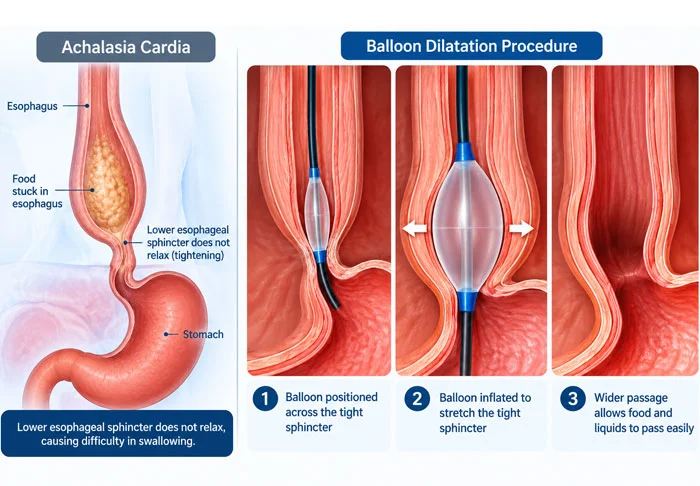
Achalasia cardia is a condition in which the lower esophageal sphincter does not relax normally, making it difficult for food and liquids to pass into the stomach.
Pneumatic dilatation uses a specialized balloon to stretch the tight sphincter and improve the passage of food.
Symptoms of Achalasia
- Difficulty swallowing
- Regurgitation of food or liquids
- Chest discomfort
- Night-time coughing
- Unexplained weight loss
How is Dilatation Performed?
During the procedure, a specialized balloon is positioned across the lower esophageal sphincter and carefully inflated. This stretches the tight muscle and helps improve the passage into the stomach.
The procedure is performed under specialist guidance, and some patients may require repeat treatment depending on their response.
Benefits
- Improves swallowing
- Reduces food and liquid retention
- Helps relieve regurgitation
- Minimally invasive treatment
- May provide lasting symptom relief
Possible Risks
- Chest discomfort
- Acid reflux
- Minor bleeding
- Esophageal perforation, which is uncommon
- Recurrence of symptoms
Conclusion
Achalasia cardia dilatation is a minimally invasive treatment that helps relax the tight lower esophageal sphincter and improve swallowing. Proper diagnosis and follow-up with a gastroenterologist are important for long-term management.
- Home
- Know Your Consultant
- Our Specialisations
- Diseases We Treat
- Endoscopy and Other Procedures We Do
- Upper GI tract endoscopy
- Colonoscopy
- Sigmoidoscopy
- Management of gastrointestinal bleeds
- Stricture dilatation
- Fistula closure
- Esophageal stenting for malignancies
- Achalasia cardia dilatation
- Colonic decompression
- PEG
- Colonic stricture dilatation and colonic stent placement
- Endo-sonography (EUS)
- Therapeutic EUS
- Third space endoscopy
- Motility
- Blog