Achalasia Cardia
Achalasia Cardia
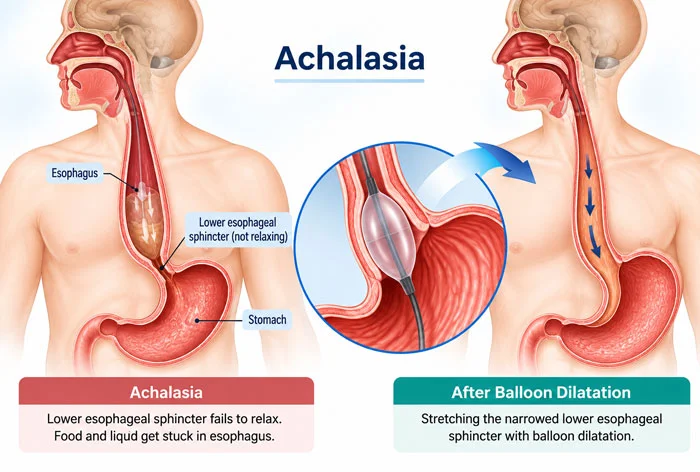
Achalasia cardia is a rare disorder of the esophagus in which the lower esophageal sphincter does not relax normally during swallowing. The muscles of the esophagus may also lose their ability to move food effectively toward the stomach.
As a result, food and liquids can accumulate in the esophagus instead of passing normally into the stomach. Over time, the esophagus may become enlarged and swallowing difficulties may progressively worsen.
Symptoms of Achalasia
Symptoms may develop gradually and can become more noticeable over time. Common symptoms include:
- Difficulty Swallowing: Difficulty passing both solid foods and liquids from the esophagus into the stomach.
- Regurgitation: Undigested food or liquids may come back into the mouth, particularly when lying down.
- Chest Pain: Some patients may experience pressure, discomfort, or pain behind the breastbone.
- Weight Loss: Persistent swallowing difficulty may lead to reduced food intake and unintended weight loss.
- Heartburn-Like Symptoms: Regurgitation and retained food may sometimes feel similar to acid reflux.
- Coughing at Night: Regurgitated food or liquid may enter the throat and cause nighttime coughing.
- Feeling of Food Sticking: Patients may feel that food remains stuck in the chest after swallowing.
What Causes Achalasia?
The exact cause of achalasia is not fully understood. It is believed to involve damage or loss of nerve cells in the esophageal wall that control swallowing and relaxation of the lower esophageal sphincter.
- Loss of Esophageal Nerve Function: Damage to the nerves controlling esophageal muscle activity can interfere with normal swallowing.
- Failure of Lower Esophageal Sphincter Relaxation: The sphincter remains tightly closed instead of relaxing when food reaches the lower esophagus.
- Reduced Esophageal Motility: The normal coordinated contractions that move food toward the stomach become impaired.
- Secondary Achalasia: Rarely, conditions such as certain tumors or infections can produce symptoms resembling achalasia.
Types of Achalasia
Achalasia is commonly classified into three types based on findings from high-resolution esophageal manometry.
- Type I Achalasia: There is minimal or absent normal esophageal contraction along with impaired relaxation of the lower esophageal sphincter.
- Type II Achalasia: The esophagus develops abnormal pressurization during swallowing and is the most commonly recognized subtype.
- Type III Achalasia: Spastic or premature contractions occur in the esophagus along with impaired relaxation of the lower esophageal sphincter.
Diagnosis of Achalasia
A combination of tests is generally used to confirm achalasia and rule out other causes of swallowing difficulty.
- Upper GI Endoscopy: Endoscopy is used to examine the esophagus and stomach and exclude tumors, strictures, or other structural abnormalities.
- High-Resolution Manometry: This is the key test for confirming achalasia and measuring pressure and muscle activity within the esophagus.
- Barium Swallow: A contrast X-ray can demonstrate impaired passage of contrast into the stomach and characteristic narrowing at the lower esophageal sphincter.
- Timed Barium Esophagram: This test can help assess how quickly contrast passes through the esophagus.
- Endoscopic Ultrasound or CT: Additional imaging may be recommended when a structural abnormality or pseudoachalasia is suspected.
Treatment Options for Achalasia
Treatment aims to reduce the pressure at the lower esophageal sphincter and allow food to pass more easily into the stomach. The choice of treatment depends on the type of achalasia, severity of symptoms, and overall health.
- Pneumatic Balloon Dilatation: A specialized balloon is used to stretch and disrupt the muscle fibers of the lower esophageal sphincter.
- POEM: Peroral endoscopic myotomy is a minimally invasive endoscopic procedure that cuts selected muscle fibers of the lower esophageal sphincter to improve food passage.
- Laparoscopic Heller Myotomy: A surgical procedure in which the muscles of the lower esophageal sphincter are divided to allow easier passage of food.
- Botulinum Toxin Injection: Botox can temporarily relax the lower esophageal sphincter and may be considered for selected patients who are not suitable for definitive procedures.
- Medications: Certain medicines may temporarily reduce sphincter pressure but are generally less effective than definitive treatments.
Peroral Endoscopic Myotomy (POEM)
Peroral endoscopic myotomy (POEM) is an advanced endoscopic treatment for achalasia. During the procedure, an endoscope is passed through the mouth and a small tunnel is created within the esophageal wall. The muscle fibers responsible for the abnormal sphincter pressure are then divided to improve the passage of food into the stomach.
POEM may be particularly useful for patients with spastic forms of achalasia, although the most appropriate treatment should be determined after specialist evaluation.
Possible Complications
If achalasia remains untreated, persistent food retention and pressure within the esophagus may lead to complications.
- Esophageal Dilatation: Long-standing obstruction can cause the esophagus to become enlarged.
- Food Retention: Food and liquids may remain in the esophagus for prolonged periods.
- Aspiration: Regurgitated food or liquid may enter the airway and cause respiratory problems.
- Respiratory Symptoms: Chronic regurgitation can result in coughing, recurrent chest infections, or breathing difficulties.
- Weight Loss and Malnutrition: Difficulty eating may lead to inadequate nutritional intake.
- Esophagitis: Retained food and secretions can cause inflammation of the esophageal lining.
Diet and Lifestyle Measures
Lifestyle measures can help manage symptoms, although they do not correct the underlying muscle dysfunction.
- Eat Slowly: Taking sufficient time to chew food thoroughly may make swallowing easier.
- Drink Water With Meals: Water may help move food through the esophagus in some patients.
- Smaller Meals: Eating smaller portions more frequently may be better tolerated.
- Remain Upright: Staying upright after meals may help reduce regurgitation.
- Follow Specialist Advice: Dietary recommendations should be individualized according to symptoms and treatment.
Long-Term Follow-Up
Patients treated for achalasia may require long-term follow-up because symptoms can recur and some treatments can increase the risk of gastroesophageal reflux.
Follow-up may include assessment of swallowing symptoms, nutritional status, endoscopy, or other tests when clinically indicated.
When to Consult a Specialist?
Persistent difficulty swallowing, recurrent regurgitation, unexplained weight loss, chest discomfort, or coughing after meals should be evaluated by a gastroenterologist or esophageal specialist.
Early diagnosis and appropriate treatment of achalasia can improve swallowing, reduce food retention, and help prevent long-term complications.