ERCP
Endoscopic Retrograde Cholangiopancreatography (ERCP)
ERCP is a specialized endoscopic procedure used to diagnose and treat conditions affecting the bile ducts, pancreatic duct, gallbladder drainage system, and surrounding pancreato-biliary structures.
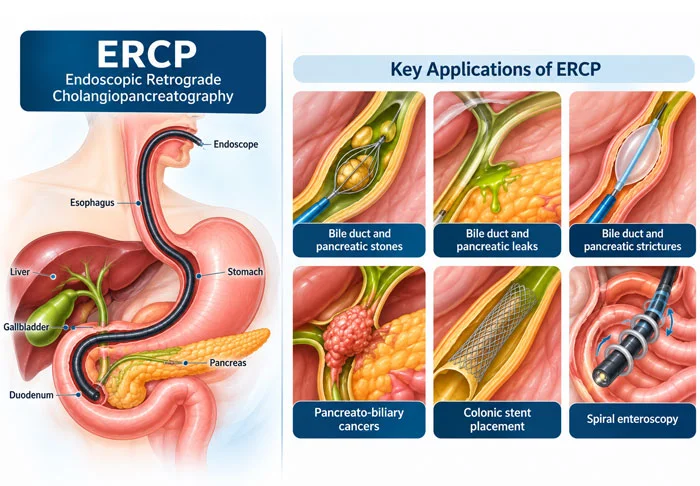
ERCP combines endoscopy with X-ray imaging to access the bile and pancreatic ducts. It allows the specialist to identify blockages, narrowing, leaks, stones, and other abnormalities and, when required, provide treatment during the same procedure.
Modern ERCP is primarily used as a therapeutic procedure, particularly when an abnormality of the bile or pancreatic ducts requires endoscopic intervention.
When is ERCP Performed?
ERCP may be recommended when imaging or clinical findings suggest a problem within the bile or pancreatic ducts that may require endoscopic treatment.
- Bile duct or pancreatic stones
- Bile duct or pancreatic leaks
- Bile duct or pancreatic strictures
- Obstruction of the bile or pancreatic ducts
- Pancreato-biliary cancers
- Selected cases of obstructive jaundice
- Selected postoperative or procedure-related duct complications
Bile Duct and Pancreatic Stones
Common bile duct stones can obstruct the normal flow of bile and may cause jaundice, abdominal pain, infection, or pancreatitis.
During ERCP, the bile duct can be accessed and stones may be removed using specialized endoscopic techniques. A small cut at the duct opening, known as sphincterotomy, may be performed when appropriate.
Selected pancreatic duct stones, particularly those associated with chronic pancreatitis, may also be managed using advanced endoscopic techniques.
Depending on the size and location of the stone, extraction, dilation, or other specialized interventions may be performed.
Bile Duct and Pancreatic Leaks
ERCP can help identify and treat selected bile duct and pancreatic duct leaks, including leaks that may occur after surgery, trauma, or other procedures.
A temporary stent may be placed across or near the affected area to redirect bile or pancreatic fluid and support healing.
Appropriate endoscopic management may help restore normal drainage and allow the affected duct to heal in selected cases.
Bile Duct and Pancreatic Strictures
A stricture is a narrowed section of a bile or pancreatic duct. It may develop due to inflammation, chronic pancreatitis, previous surgery, or malignancy.
During ERCP, selected strictures may be treated using balloon dilatation and/or stent placement to improve duct drainage.
- Bile Duct Strictures: Narrowing of the bile duct can interfere with normal bile drainage and may result in jaundice or other complications.
- Pancreatic Duct Strictures: Narrowing of the pancreatic duct may be associated with chronic pancreatitis and can affect pancreatic drainage.
- Balloon Dilatation: Selected narrowed areas may be gently widened using specialized endoscopic balloons.
- Stent Placement: A stent may be placed to maintain duct drainage when clinically appropriate.
Pancreato-Biliary Cancers
Cancers involving the bile ducts, pancreas, gallbladder, or surrounding structures may obstruct the normal flow of bile.
In selected patients, ERCP can be used to relieve obstruction by placing a biliary stent. This may help improve bile drainage and relieve symptoms such as obstructive jaundice.
ERCP may also assist in obtaining tissue samples from selected duct abnormalities when clinically appropriate.
- Bile Duct Cancer: Tumours affecting the bile ducts may cause narrowing or obstruction.
- Pancreatic Cancer: A pancreatic tumour may compress or involve the bile duct and interfere with bile drainage.
- Gallbladder Cancer: Selected cases may involve the surrounding biliary structures.
- Biliary Stenting: A stent may be used in appropriate cases to maintain bile drainage.
How is ERCP Performed?
ERCP is performed using a specialized side-viewing endoscope. The endoscope is passed through the mouth into the duodenum, where the openings of the bile and pancreatic ducts are identified.
A small catheter is introduced into the required duct and contrast material may be injected while X-ray images are obtained.
Once the abnormality is identified, appropriate treatment such as stone removal, sphincterotomy, balloon dilatation, stent placement, or leak management can be performed.
ERCP for Stent Placement
Stents may be placed inside the bile or pancreatic ducts to maintain drainage when a duct is narrowed or blocked.
Depending on the condition, the specialist may use a plastic or self-expanding metal stent. The choice depends on the underlying disease, location of the obstruction, and treatment plan.
Spiral Enteroscopy
Spiral enteroscopy is an advanced endoscopic technique that can help reach deeper sections of the small intestine using a specialized spiral-equipped enteroscope.
In selected patients with altered gastrointestinal anatomy, spiral enteroscopy may assist in reaching difficult-to-access areas and can be useful for advanced pancreato-biliary interventions when conventional ERCP access is not possible.
- Access to deeper sections of the small intestine
- Useful in selected patients with altered gastrointestinal anatomy
- Can assist with difficult-to-access pancreato-biliary anatomy
- May facilitate advanced endoscopic interventions in selected cases
Cholangio-Pancreatoscopy
Cholangio-pancreatoscopy allows direct visualization of the inside of the bile and pancreatic ducts using a miniature endoscopic system.
It can provide detailed assessment of duct stones, strictures, and selected suspicious duct lesions. In appropriate cases, targeted tissue sampling or specialized stone treatment may also be performed.
- Direct Duct Visualization: Allows the inner surface of the bile or pancreatic duct to be examined.
- Stone Assessment: Helps evaluate selected difficult duct stones.
- Stricture Assessment: Provides detailed visualization of selected duct strictures.
- Suspicious Lesions: Selected abnormal duct areas may be evaluated more closely.
- Targeted Sampling: Tissue sampling may be considered when clinically appropriate.
Benefits of ERCP
- Direct access to the bile and pancreatic ducts
- Allows treatment of selected duct stones
- Can relieve bile duct obstruction
- Allows treatment of selected duct strictures and leaks
- Enables biliary and pancreatic stent placement
- Can provide targeted evaluation of selected duct abnormalities
- May avoid the need for more invasive procedures in appropriate cases
Preparation Before ERCP
Patients are generally required to fast before the procedure. The doctor should be informed about all medications, allergies, and existing medical conditions, particularly the use of blood-thinning medicines.
Depending on the patient's condition and the planned intervention, blood tests and imaging may be reviewed before ERCP.
- Follow fasting instructions provided by the medical team.
- Inform the doctor about all medications.
- Discuss the use of blood-thinning medicines.
- Inform the medical team about known allergies.
- Share details of existing medical conditions.
After the Procedure
Patients are monitored after ERCP, particularly if sedation or anesthesia has been used.
Depending on the procedure performed, patients may initially be advised to follow specific dietary and medication instructions. Further follow-up may be required, especially when a temporary stent has been placed.
Patients should promptly report severe abdominal pain, fever, persistent vomiting, bleeding, or worsening jaundice after the procedure.
Possible Risks
ERCP is an advanced procedure and, although generally performed safely by experienced specialists, complications can occur.
- Abdominal discomfort or bloating
- Pancreatitis
- Bleeding, particularly after sphincterotomy
- Infection
- Perforation, which is uncommon
- Stent blockage or migration
- Reaction to sedation or contrast material
Follow-up After ERCP
Follow-up depends on the underlying condition and treatment performed. Patients with temporary stents may require a planned procedure for stent removal or exchange.
Patients should promptly report severe abdominal pain, fever, persistent vomiting, bleeding, or worsening jaundice after the procedure.
Conclusion
ERCP is an advanced therapeutic endoscopic procedure used for a wide range of bile duct and pancreatic duct conditions. It can help manage stones, leaks, strictures, and pancreato-biliary cancers through techniques such as stone extraction, dilatation, sphincterotomy, and stent placement.
Advanced technologies such as spiral enteroscopy and cholangio-pancreatoscopy can further expand the ability to evaluate and treat complex pancreato-biliary conditions in selected patients.