Endosonography (EUS) – Motility Evaluation
Esophageal Motility Evaluation
Esophageal motility evaluation is performed to assess how effectively the esophagus moves food and liquids from the mouth into the stomach. Patients with difficulty swallowing, regurgitation, chest discomfort or suspected esophageal motility disorders may require specialized physiologic testing. High-resolution esophageal manometry (HRM) provides detailed information about esophageal contractions and relaxation of the lower esophageal sphincter.
These investigations are particularly useful in the evaluation of dysmotility, achalasia cardia and selected patients being assessed before anti-reflux surgery such as fundoplication.
Motility
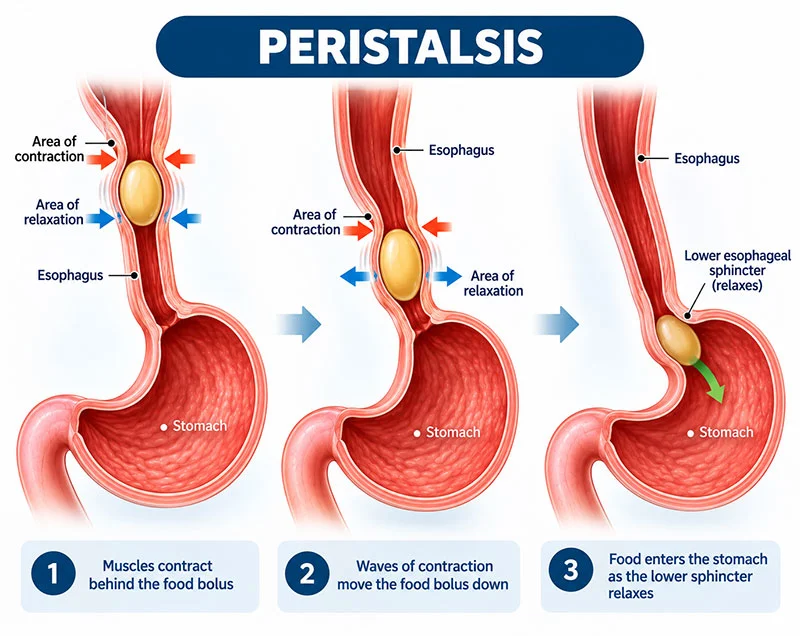
Esophageal motility refers to the coordinated muscular activity that moves swallowed food and liquid through the esophagus into the stomach.
Disorders of esophageal motility can interfere with normal swallowing and may cause symptoms such as dysphagia, regurgitation, chest discomfort or a sensation of food sticking in the chest.
When structural abnormalities do not adequately explain these symptoms, esophageal physiologic testing can help evaluate the function of the esophagus.
- Swallowing Function: Evaluates the coordinated movement of the esophageal muscles.
- Peristalsis: Assesses the contraction pattern responsible for moving food toward the stomach.
- Lower Esophageal Sphincter: Evaluates relaxation and pressure at the junction between the esophagus and stomach.
- Motor Disorders: Helps identify clinically relevant abnormalities in esophageal movement.
High Resolution Esophageal Manometry for Dysmotility
High-resolution esophageal manometry (HRM) is a specialized test used to measure pressure and contraction patterns throughout the esophagus.
During the examination, a thin pressure-sensitive catheter is passed through the nose into the esophagus. The patient performs a series of swallows while the system records pressure changes along the esophagus and at the lower esophageal sphincter.
HRM is an important investigation for patients with suspected esophageal motor disorders and provides detailed information that can help classify different patterns of dysmotility.
- Esophageal Contractions: Measures the strength and coordination of esophageal contractions.
- Peristalsis: Evaluates whether normal sequential contractions occur after swallowing.
- LES Relaxation: Assesses relaxation of the lower esophageal sphincter during swallowing.
- Motor Disorders: Helps identify major esophageal motility disorders.
- Detailed Pressure Mapping: Provides high-resolution pressure data along the esophagus.
Evaluation of Esophageal Dysmotility
Esophageal dysmotility occurs when the normal movement or coordination of the esophagus is disturbed.
Symptoms may include difficulty swallowing, chest discomfort, regurgitation or a sensation that food is not passing normally into the stomach.
High-resolution manometry can help characterize the underlying motor pattern when structural causes have been excluded or do not adequately explain the symptoms.
- Difficulty swallowing solids or liquids
- Regurgitation
- Non-cardiac chest discomfort
- Abnormal esophageal contractions
- Suspected outflow obstruction
- Evaluation of unexplained esophageal symptoms
Achalasia Cardia
Achalasia cardia is an esophageal motility disorder characterized by impaired relaxation of the lower esophageal sphincter and abnormal or absent normal peristalsis.
Patients commonly present with difficulty swallowing, regurgitation and sometimes chest discomfort or weight loss.
High-resolution manometry is the current gold-standard physiologic test for confirming achalasia and can distinguish different manometric subtypes based on esophageal contraction and pressurization patterns.
- Type I Achalasia: Characterized by absent normal peristalsis without significant panesophageal pressurization.
- Type II Achalasia: Characterized by absent normal peristalsis with panesophageal pressurization.
- Type III Achalasia: Characterized by spastic or premature esophageal contractions.
- Diagnostic Evaluation: Endoscopy and/or barium imaging may be used alongside HRM to evaluate symptoms and exclude other causes.
- Treatment Planning: Manometric findings can help inform selection of an appropriate treatment approach.
Diagnostic Evaluation of Achalasia
Evaluation of suspected achalasia generally involves more than one investigation. Upper endoscopy can help exclude mechanical obstruction and pseudoachalasia, while barium studies can provide information about esophageal emptying and morphology.
High-resolution manometry confirms the diagnosis and classifies the achalasia subtype. These findings can help guide subsequent treatment planning.
- Upper Endoscopy: Helps exclude structural obstruction and other causes of dysphagia.
- High-Resolution Manometry: Confirms the physiologic diagnosis and classifies achalasia.
- Timed Barium Esophagram: Can assess esophageal emptying and may complement other investigations.
- FLIP: Functional lumen imaging may provide additional information about esophagogastric junction opening in selected cases.
Preoperative Before Fundoplication
High-resolution esophageal manometry may be performed before anti-reflux surgery such as fundoplication to evaluate esophageal motor function and help identify significant motility disorders.
Assessment of esophageal motility can provide useful information when planning surgery for patients with reflux symptoms, particularly when the diagnosis or esophageal motor function requires objective evaluation.
The American College of Gastroenterology notes that esophageal manometry is used in patients being considered for anti-reflux surgery to assess esophageal function.
- Esophageal Function: Evaluates peristaltic function before surgery.
- Motility Disorders: Helps identify clinically significant motor abnormalities.
- LES Assessment: Provides information about lower esophageal sphincter function.
- Surgical Planning: Findings can contribute to the overall preoperative assessment.
- Complementary Testing: Manometry may be considered alongside endoscopy and reflux testing depending on the clinical situation.
When May High-Resolution Manometry Be Recommended?
Esophageal physiologic testing is generally considered when symptoms suggest a motility disorder or when additional functional information is needed after appropriate initial evaluation.
- Unexplained difficulty swallowing
- Suspected achalasia
- Suspected esophageal motility disorder
- Persistent symptoms when structural evaluation is unrevealing
- Preoperative evaluation before selected anti-reflux surgery
- Assessment of esophageal motor function in selected clinical situations
How High-Resolution Esophageal Manometry is Performed?
A thin catheter containing multiple pressure sensors is gently passed through the nose into the esophagus. After the catheter is positioned, the patient is asked to perform a series of standardized swallows.
The sensors record pressure changes along the esophagus and lower esophageal sphincter. Specialized software then displays the pressure patterns as a high-resolution topographic map for interpretation.
The procedure is generally performed without sedation because normal swallowing and esophageal motor function need to be assessed during the examination.
Preparation Before Manometry
Patients are generally given instructions regarding fasting and medications before the examination. Specific preparation may vary according to the laboratory and clinical indication.
- Fasting: Follow the fasting instructions provided by the motility laboratory.
- Medication Review: Inform the doctor about all medications being taken.
- Previous Reports: Bring relevant endoscopy, imaging and previous investigation reports.
- Medical History: Inform the medical team about previous esophageal or gastrointestinal procedures.
After the Procedure
Most patients can return to their usual activities after esophageal manometry. Temporary nasal or throat discomfort may occur because of catheter placement.
The recorded pressure data are analyzed by the specialist using established classification criteria. Results are then interpreted together with symptoms and other investigations.
Benefits of Esophageal Motility Testing
- Provides detailed information about esophageal motor function
- Helps diagnose major esophageal motility disorders
- Supports confirmation and classification of achalasia
- Evaluates lower esophageal sphincter relaxation
- Can contribute to preoperative assessment before anti-reflux surgery
- Provides objective physiologic information when structural investigations are insufficient
Conclusion
Esophageal motility testing plays an important role in evaluating patients with dysphagia and suspected motor disorders.
High-resolution esophageal manometry provides detailed information about esophageal contractions and lower esophageal sphincter relaxation and is the established physiologic test for confirming achalasia. It can also form part of the preoperative assessment for selected patients being considered for fundoplication.
For accuracy, this motility assessment should be presented as a complementary service alongside EUS rather than as an EUS procedure itself.